Full-Back or Wing-Back: Where the Job Changes
Full-back or wing-back depends on the team’s shape: learn where each starts, what the role asks for, and how to read a player whose job changes.
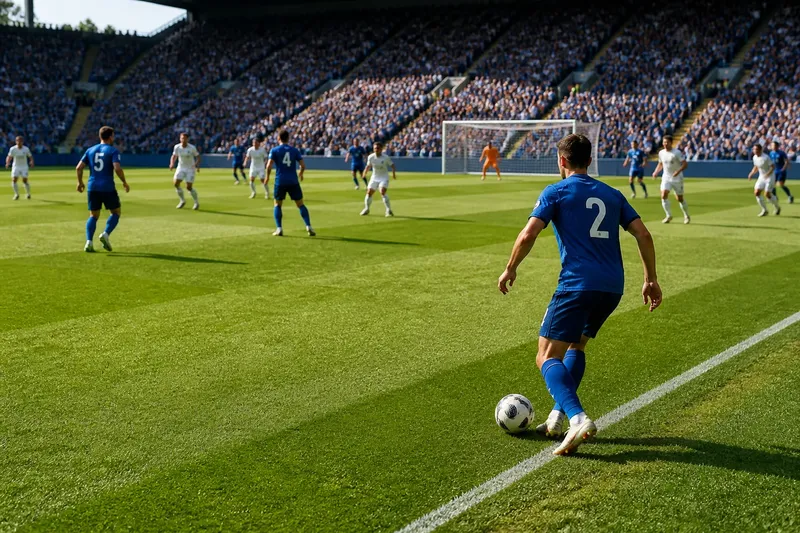
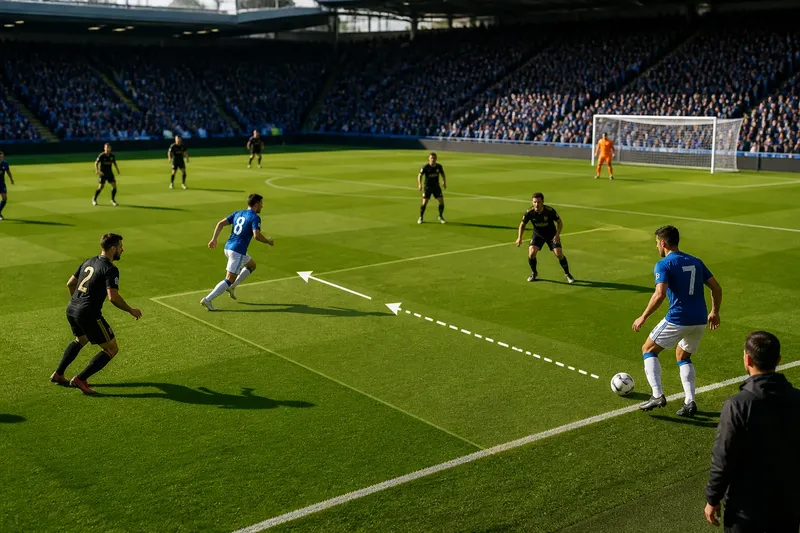
A right-sided defender receives the ball near the touchline while his team builds from the back. In one shape, he stays close to the center-backs and advances when the moment opens; in another, he begins much higher and is already a wide outlet. The difference between a full-back and a wing-back is not a badge attached to the player. It is a job set by the team’s structure.
To decide which label fits, start with the players around the wide defender, then check the defender’s starting position and responsibilities. A player can perform both roles in different matches, or even shift between them as the game develops. The name matters less than the work the shape assigns.
Read the shape before naming the role
A full-back usually belongs to a back four: two center-backs, a left-back and a right-back. The wide defenders begin as the outer members of the defensive line. They may push forward to support attacks, but the structure still gives each one a clear partner inside and expects the line to protect the width of the penalty area.
A wing-back is commonly the wide player in a back three. Three central defenders cover the middle, while the wing-backs provide much of the team’s width. They often start higher than full-backs and may have to run the length of the flank, supporting attacks and recovering into a five-player defensive line when possession is lost.
Those are common arrangements, not rigid definitions. A back four can use an attacking full-back who spends long spells high up the pitch. A back three can ask its wing-backs to hold deeper positions. Look at the repeated duties, rather than judging from one frame or the formation graphic shown before kickoff.
Choose full-back when the team needs a defender in a back four
If the team has two center-backs and two wide defenders forming its main defensive line, full-back is usually the clearest label. The player’s first reference point is the opposing winger or wide attacker, and the player must help keep the line compact without surrendering the flank.
In possession, a full-back might overlap the winger, offer a short pass behind the midfield, or stay back while the other side advances. Which option fits depends on the team’s plan and the risks it accepts. Because the back four has only two center-backs, a full-back’s forward run can leave space behind; a midfielder or the far-side defender may adjust to cover it.
Choose this reading when you see a player repeatedly retreating into line with the center-backs, tracking a wide opponent, and advancing selectively from that deeper base. The player can still be one of the team’s main attacking outlets. The point is that forward support sits alongside a standing duty to defend as part of four.
Choose wing-back when the wide player supplies the flank
If three central defenders form the main line and a wide player is positioned outside them, wing-back is usually the better fit. The team’s shape gives that player more room to start forward, but also makes the flank a larger area to cover. A wing-back can be asked to provide width, carry the ball, cross, and recover into the defensive line.
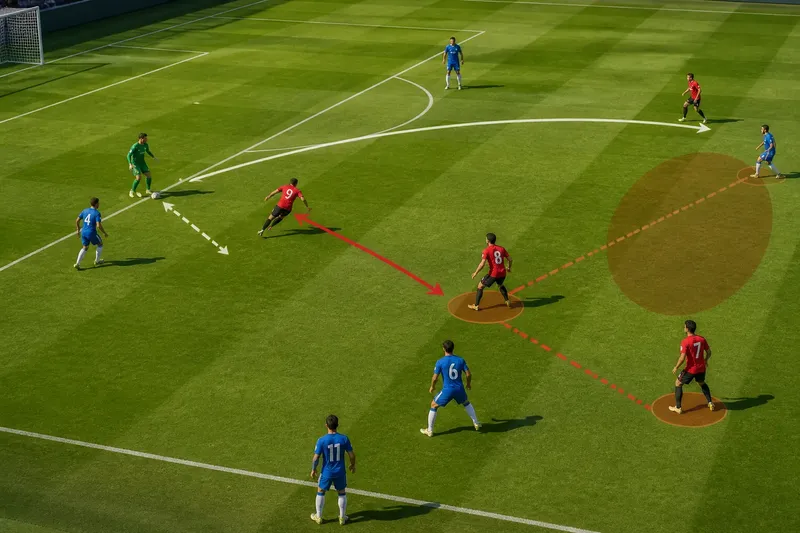
That workload changes the nearby relationships. A wide forward may move inside because the wing-back is holding the outside lane. The nearest central midfielder may slide toward the flank when the wing-back advances, while the outside center-back has to be ready to defend the channel behind. The role is therefore not simply “an attacking full-back”; it is part of how the whole formation balances its width.
Choose this reading when the player starts well ahead of the outside center-back, regularly becomes the team’s widest attacker, and is expected to drop into a line of five without the ball. If the player stays deep and behaves much like a conventional defender, the label may be less useful than noting that the team is using a cautious wing-back.
Use the team’s shape to settle borderline cases
Some teams change the apparent role during a match. A full-back may move into central midfield during possession, while a wing-back may drop beside the center-backs when the team defends. Those movements do not automatically rename the player. Ask what the player does in the team’s settled defensive shape and how the team creates its attacking width.
Say a team lists a right-back in a back four, but during possession he steps into midfield while the left-back stays deep. The right-sided player is still best understood as a full-back whose team gives him an inverted role; the left-back remains a full-back with a more conservative assignment. The observable distinction is where each begins and what space each is expected to occupy, not the fact that one has crossed into midfield.
Now imagine a team with three center-backs and two wide players who start near the halfway line. When the opponents attack, those wide players retreat outside the center-backs to form a line of five. Wing-back fits because the players provide the flank in attack and complete the defensive line in recovery. These labels describe the structure, not the player’s permanent identity.
Full-back or wing-back depends on these match clues
How many central defenders form the base?
Two center-backs with a defender on each side usually point to full-backs. Three center-backs with wide players positioned beyond them usually point to wing-backs, especially when those wide players also form the outside members of a defensive five.
Where does the wide defender start?
A player beginning level with the center-backs is more likely to be a full-back. A player regularly starting higher, closer to midfield or the wide forward, is more likely to be a wing-back, though a team can make exceptions.
Who is expected to provide the attacking width?
If the winger stays wide and the defender supports from behind, full-back is a useful reading. If the wide forward moves inward and the defender occupies the touchline, the role is more wing-back-like because the defender is supplying the flank.
What happens when the team loses the ball?
Watch whether the player immediately returns to a back four or drops outside three center-backs to complete a line of five. That recovery position often clarifies the role more reliably than an isolated overlap or a single advanced starting position.
Compare the roles without turning them into a ranking
Neither role is inherently more attacking, more demanding, or more important. A full-back can spend much of a match high on the flank, while a wing-back can be asked to defend cautiously. Their distinguishing feature is the structure around them and the range of spaces the team expects them to cover.
The useful comparison is between assignments. A full-back in a back four has a direct place in a four-player defensive line and may need to coordinate with the winger ahead. A wing-back in a back three often carries more responsibility for providing width, while the central defenders and midfielders adjust around that movement. Both can defend, create chances, and support possession; the team distributes those tasks differently.
For a clear match reading, note the defensive line, the wide player’s starting position, and who holds the touchline in attack. If those clues point in different directions, describe the player’s actual behavior before settling on a label. Full-back or wing-back is most useful when it explains the team’s shape, not when it is treated as a fixed description of the player.
Next time a defender surges forward, watch the teammates behind him. Their shifts reveal whether he has made a routine full-back run or is carrying the wing-back’s larger share of the flank—and they explain why the same player can be asked to do different work in a different shape.