How the Half-Space Shapes Football Attacks
Learn how the football half-space connects wide play to central attacks, gives receivers more passing angles, and helps you read defenders’ choices.
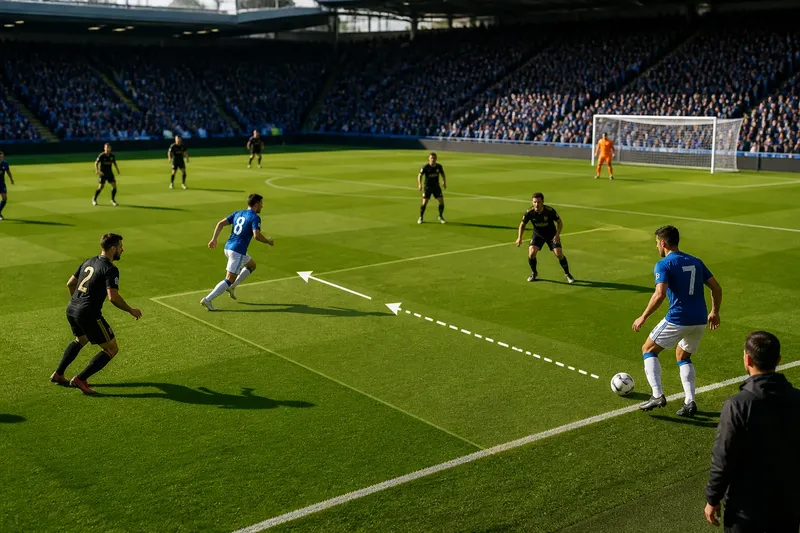
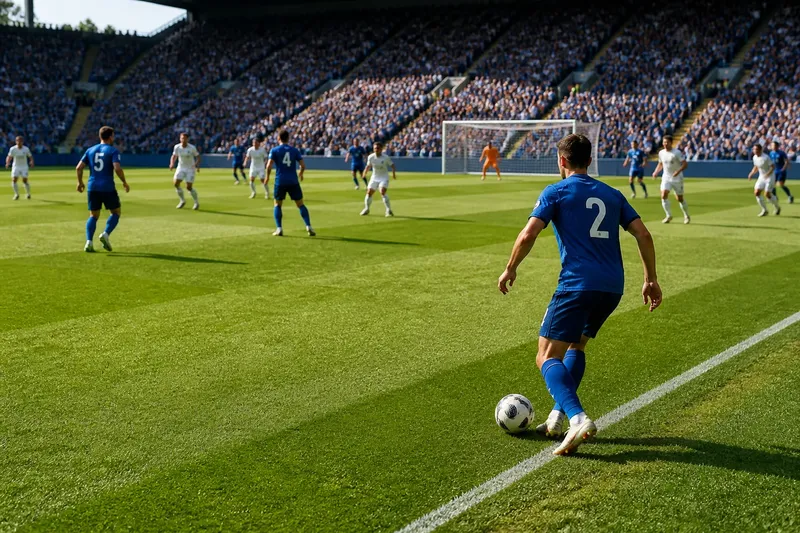
A winger controls the ball beside the touchline while a midfielder moves into the channel just inside them. The football half-space is that corridor between the center and the flank, where a receiver can connect those two positions and give defenders another problem to track.
Its value is not tied to a marked strip of turf. It comes from the angles a player creates, the teammates nearby, and the defensive response that follows.
The half-space is a reference lane, not a marked zone
The pitch has touchlines and penalty-area markings, but no official lines dividing it into tactical lanes. Coaches and analysts often picture five vertical channels: a central lane, a half-space on each side, and a wide lane beside each touchline. This is a viewing aid, not a rule of the game.
The half-space lies between the central area and the outside channel. A player there may be closer to goal than a winger while remaining outside the densest central traffic. Its precise location shifts with the ball, the team’s shape, and the player’s task.
Think of the lane as a relationship between players. An attacker occupies it in a meaningful way when their position offers a distinct passing angle or makes a defender account for them. Standing in the corridor without affecting either is mostly a geographical achievement.
The football half-space offers a receiver several routes
A touchline receiver has the sideline limiting one direction to turn or pass. A central receiver may have more directions available but face pressure from several opponents. The half-space can offer a forward route toward goal, an outside pass to a winger, and an inside connection to a midfielder.
Location alone does not make a pass progressive. A receiver facing their own goal, tightly marked, or isolated from teammates may have little room to act. Watch whether they can see more than one route and whether a teammate is close enough to support the next action.
For the passer, a diagonal ball into the half-space can go around a defender screening the direct route through the center. The receiver may then turn, combine, or move the ball wide. The angle helps only if the pass reaches a useful place and the receiver can play it.
A half-space position tests defensive assignments
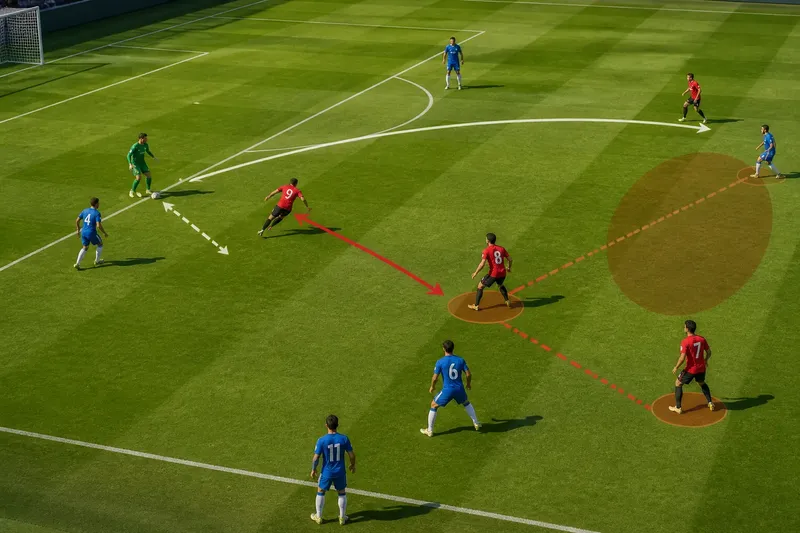
When an attacker moves inside from the flank, a nearby defender has to decide whether to follow. If a central midfielder steps across, another area may open behind or beside them. If a full-back tracks the run, the winger outside may have more room. If no one closes the receiver, they may be able to turn.
Teams handle those choices differently. One defense may pass the runner to another marker; another may ask a defender to track the opponent closely. The position tests those arrangements, but it does not dictate a mistake.
Support positions affect the choice. A winger holding the width can discourage a defender from leaving the flank. A central teammate may occupy another marker. With those options present, the half-space receiver may have a clearer route than if several attackers crowd the same area.
The lane can link wide possession to a central attack
An attack may develop near the flank, then move inside when a player receives in the half-space. From there, the receiver can look for a striker, a midfielder running forward, or the winger continuing toward the byline. Defenders must attend to the route toward goal without losing sight of the outside option.
The movement can work in reverse, too. A winger stays wide while a teammate runs inside. If a defender follows the runner, the winger may become available; if the defender stays outside, the runner may find room between the lines.
Say a team has the ball near the right touchline, its winger holding width, and a midfielder moving into the right half-space. The opponent’s full-back stays with the winger while a central midfielder steps toward the newcomer. The ball carrier now has a forward lane toward the striker if that step opens it; if the central midfielder holds position, the half-space player may have room to receive. This invented situation shows the choice to watch, not an assured outcome.
Runs through the half-space change the question
A player can hold a position in the lane or run through it as the defense shifts toward the ball. The runner may move beyond the back line, offer a pass between defenders, or draw a marker away from a teammate. What happens depends on the ball carrier’s options and the defenders’ positions.
A winger carrying inward can make room for an overlapping teammate outside. A central player can also move diagonally into the lane as the ball travels to the flank. Both movements ask defenders to track a player across their usual reference points, though they start from different places.
Several attackers arriving in the same corridor at once can make it easier for the defense to cover them together. A shape with one player between the lines and another threatening beyond can give the ball carrier distinct choices. Watch how the movement relates to the pass, rather than treating every run inside as useful by itself.
What should you watch for in the half-space?
How can you spot the half-space in a match?
Look between the central group and the nearest touchline, then note who receives there and which defenders respond. The lane is easier to recognize as the ball moves between the center and flank, because the changing passing angle becomes visible.
Why receive inside instead of staying wide?
An inside position can offer a forward-facing angle and a connection to teammates near goal. Staying wide may stretch the defense more effectively, so the choice depends on whether the attack needs width, an inside link, or a run beyond.
Does occupying the half-space always help?
No. A defender may cover the lane without difficulty, or the attacker may receive with no support nearby. Watch whether the position changes a defender’s assignment or opens a usable pass; the label alone explains little.
Can a team use the half-space without passing into it?
Yes. A runner can pull a defender inward and leave a teammate free outside, or the threat of an inside pass can hold a marker in place. The lane can shape the defense even when the ball goes elsewhere.
Defensive shapes can crowd the lane or allow a reception
A compact defense can keep its midfield and back line close enough to crowd the half-spaces. That may make central combinations harder while leaving more room outside. Another defense may allow a pass into the lane, then close around the receiver with a midfielder and full-back.
To read the response, distinguish an allowed reception that is still controlled from a gap the defense cannot address. If the receiver gets the ball facing away from goal and is quickly surrounded, the defense may be content with the situation. If the receiver turns and carries forward, the defense may have left room to exploit.
Follow the action after the first pass, too. A half-space player can release the ball and continue toward the box while a teammate moves into the vacated lane. That rotation can complicate defensive assignments; if the attackers move without coordination, it can instead crowd their own route.
Read the half-space by following the defenders
To understand a half-space attack, find the player between the center and flank, then watch whether a defender follows, hands them off, or leaves them free. Look next for the space that response creates and whether the ball carrier can reach it.
The football half-space can offer a diagonal angle, connect wide possession to a central attack, and force defenders to divide their attention, but none of those effects is automatic. As you watch, follow the defender’s choice and the pass or run that follows; that is where the lane’s tactical value becomes clear.